Louisiana Coastal Protection and Restoration Authority
Barrier Island System Management (BISM): Program Implementation and Tradeoff Analysis
2023-Ongoing
The Challenge
Initial development of BISM established a structured decision-making (SDM) workflow to prioritize barrier island restoration projects based on system-wide objectives. While this workflow enabled a more holistic and transparent approach, tools to quantitatively assess restoration alternatives and evaluate tradeoffs between cost, sediment use, and system benefits would streamline implementation
In addition, a data-driven approach would enable more robust analysis of potential restoration project portfolios, sediment resources, and future environmental uncertainties.
The Approach
In coordination with the Coastal Protection and Restoration Authority (CPRA), the Institute developed the Barrier Island Restoration Tradeoff Analysis (BIRTA) toolkit to support implementation of the BISM workflow.
The BIRTA toolkit is a system of datafiles and models linked together by a decision framework designed to leverage existing data sources; assess evolution of the Louisiana barrier island and headland system; analyze potential restoration alternatives, including sediment placement locations and use of available sediment sources; and facilitate project selection and prioritization to minimize costs while maximizing benefits to the coastal system.
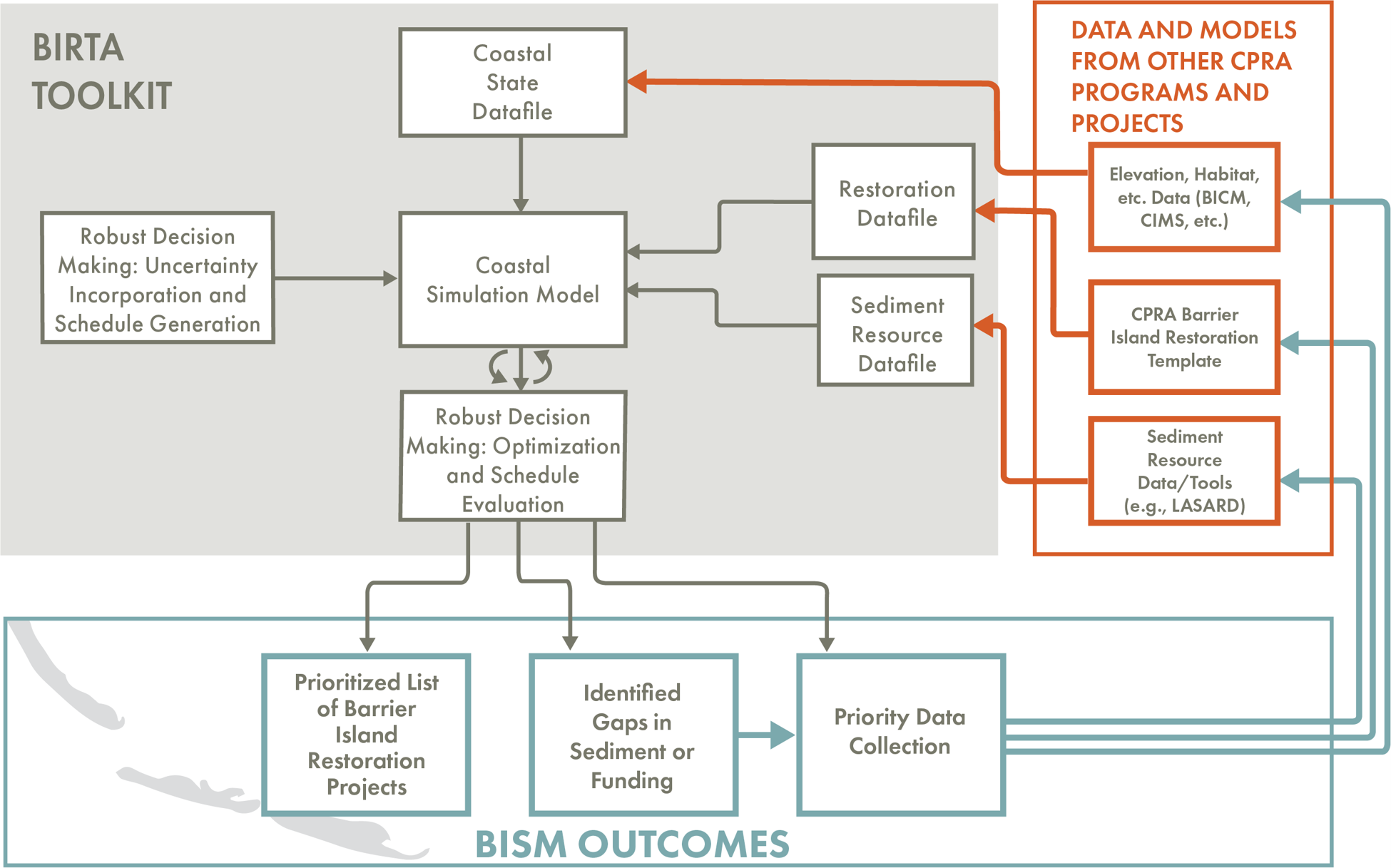
The toolkit integrates metrics to describe the state of the coast, characteristics of coastal restoration templates and sediment sources, and predictive algorithms to evaluate how barrier island systems respond to restoration actions under varying environmental conditions. It supports exploration of future scenarios, including storms and sea level rise, and evaluates associated costs and benefits across restoration alternatives.
Through this approach, BIRTA operationalizes the BISM workflow by enabling a quantitative, analysis-driven evaluation of restoration strategies and supporting identification of project portfolios that balance long-term system performance with implementation costs.
Outcomes
This effort resulted in the development and application of the BIRTA toolkit to support implementation of the BISM program. Key outcomes include:
- A system of data files and computational tools to support barrier island system assessment and restoration planning
- Quantitative evaluation of restoration alternatives and tradeoffs between cost and system benefits
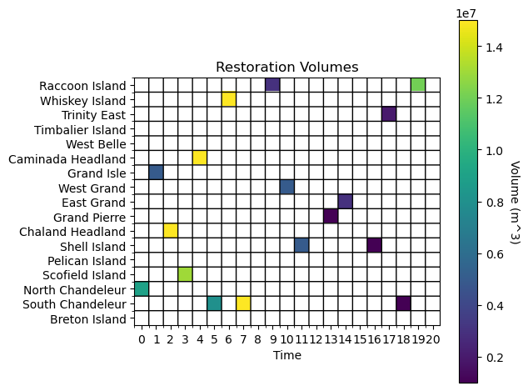
- Development of prioritized restoration project portfolios and associated sediment source strategies
- Estimates of sediment volume and funding needed to support long-term barrier island system management
The BIRTA toolkit supports ongoing implementation of BISM by providing a consistent, transparent, and quantitative framework for evaluating restoration strategies and informing decision-making for Louisiana’s coastal system.
KEY TEAM MEMBERS