FloodID®: Because Impact Starts With Understanding
FloodID® is a comprehensive, web-based flood forecasting and decision support system purpose-built for emergency managers. Developed to support needs identified in collaboration with state and local government emergency managers, FloodID® enables proactive decision-making before, during and after flood events through delivery of localized impact forecasts, real-time nowcasts, and post-event assessments.
The Water Institute and ICEYE, one of the world’s leading Earth observation companies, entered into a strategic partnership to advance and scale FloodID. Developed through years of applied research, operational testing, and partnership, FloodID began as a tool to help Louisiana make better decisions before, during, and after flood events. With ICEYE’s global reach and operational expertise across more than 30 countries, the new partnership will accelerate the deployment of FloodID across the United States and beyond.
Read how FloodID is advancing to help protect more lives and property:
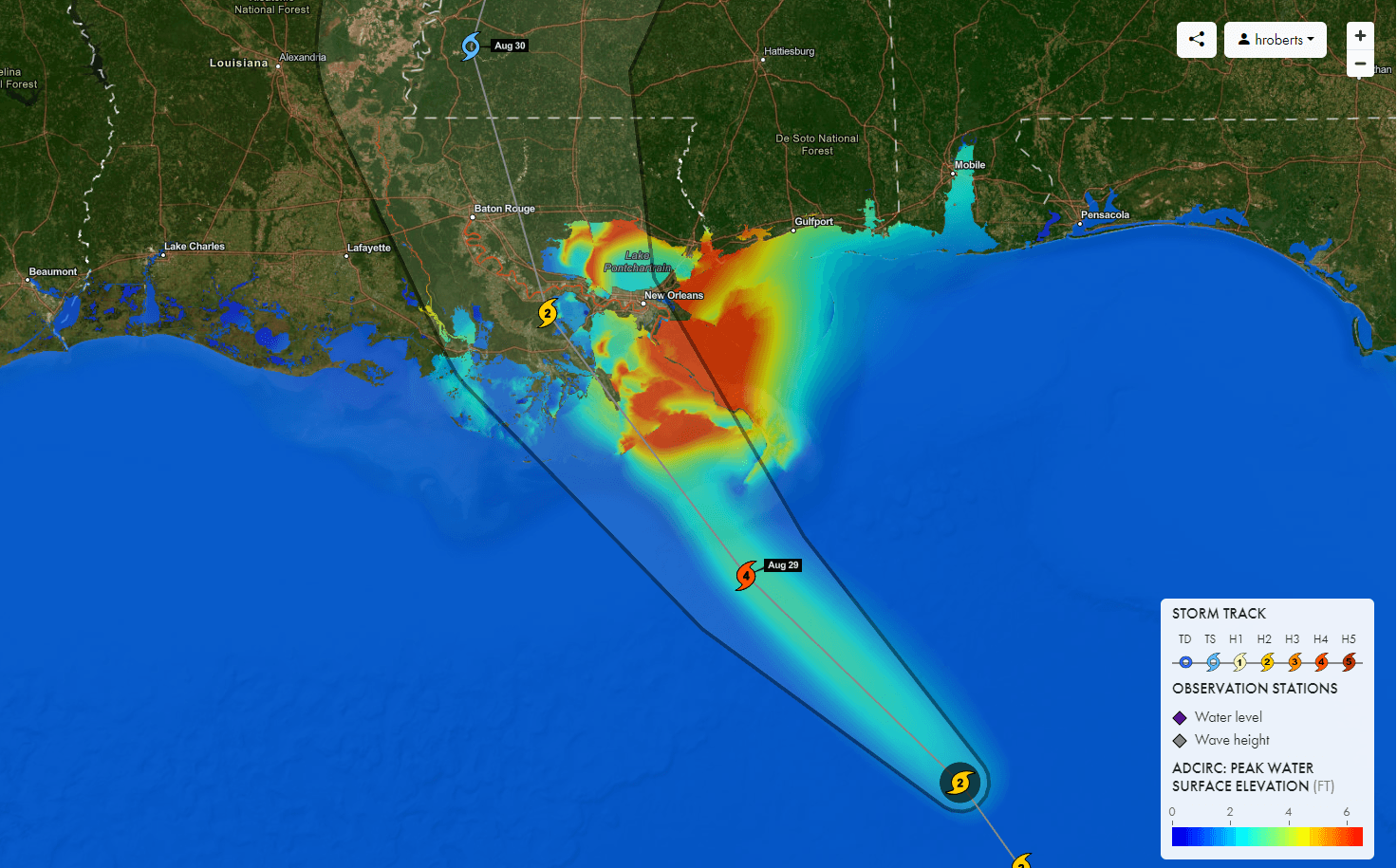
Image: FloodID® generated forecast for hurricane induced storm surge
The FloodID® dashboard streamlines access to high resolution data and decision-support tools that enable critical actions during a flood event, including:
- Evacuation planning
- Rescue operations
- Supply positioning
- Infrastructure protection
- Flood infrastructure operations
- Road closures
- Flood barrier deployment
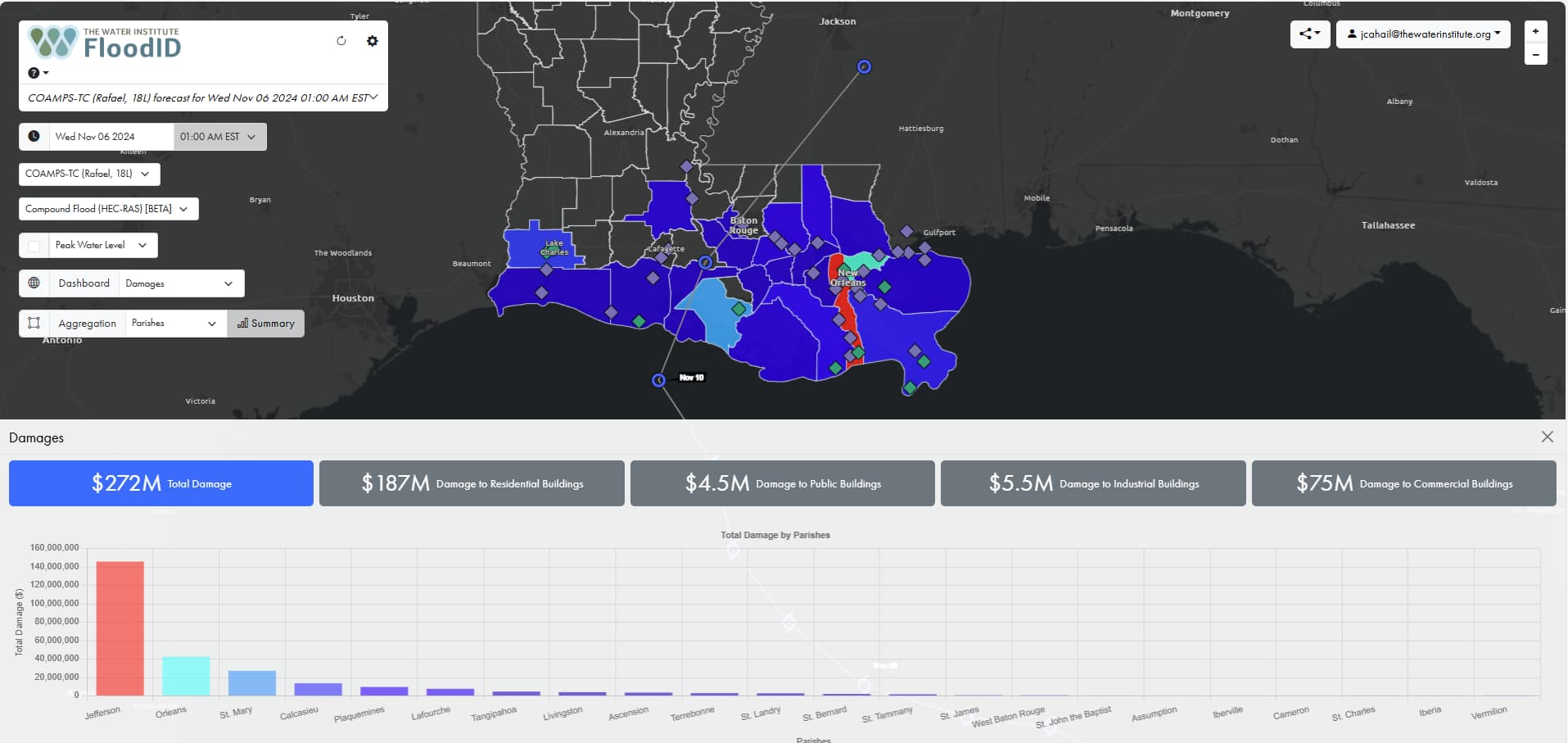
Image: Example FloodID® decision dashboard approximating damages to buildings and contents
FloodID® is uniquely designed to support government and private sector users across a range of use cases and geographies due to unique platform design that delivers:
- End-to-end functionality: From automated data retrieval to meteorological forecast and observation data, to visualizing flood data within decision support dashboards, FloodID® ensures that everything you need to make a decision lives in the same, easy-to-access user interface.
- Affordability: FloodID® was developed with limited budgets of local, regional, and state agencies in mind to ensure delivery of risk-based, reliable flood intelligence to those who need it most.
- Interoperability: The FloodID® system integrates seamlessly with external datasets and platforms, either by incorporating external datasets within the FloodID® dashboard itself or by supplying data from the FloodID® system to external dashboards and pre-existing workflows via API connection.
- Scalability: Powered by our next-generation hybrid machine learning framework, physical model, and statistical physics, the FloodID® system minimizes dependence on local sensors while maintaining forecast accuracy across diverse geographies, meteorological conditions, and hydrological characteristics
- Versatility: Regardless of your location, FloodID® supports access to flood intelligence across inland and coastal regions, including ungauged headwaters, within a single, easy-to-use system.
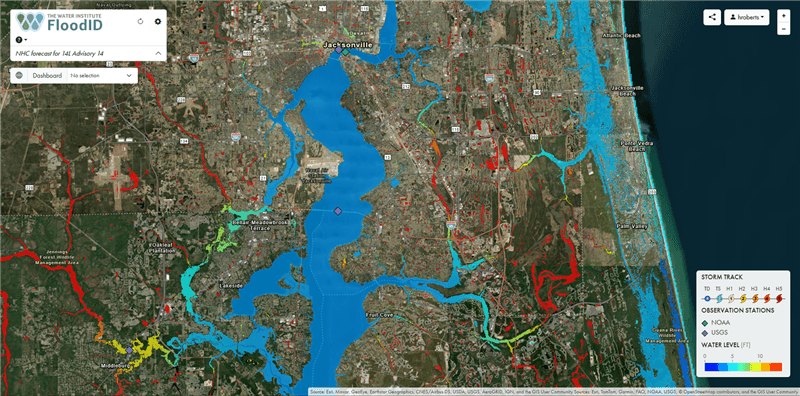
Image: FloodID® generated compound flood forecast accounting for pluvial, riverine and coastal effects along the South Atlantic coast
The FloodID® system enables operational flood intelligence for three distinct types of flooding: coastal, riverine, and pluvial. This advanced technology approach enables information in areas where compound flooding exists, as well as in ungauged areas, such as headwater catchments.
The FloodID® system can display three critical flood intelligence data layers:
- Forecast, showing where floodwaters will be ahead of a flood event. This information can be produced with a forecast horizon of up 120 hours ahead of time, with data feeds refreshed every six hours.
- Nowcast, showing where floodwaters currently are. Currently available upon request.
- Hindcast, showing where floodwaters were during a flood event. Currently available upon request.
Pricing is available upon request, based upon your organization, requirements, and geography. To request a demo or learn more, say hello at sales@floodid.org or fill out the contact form below:
FloodID® is powered by The Water Institute, an independent, non-profit, applied research institution advancing science and developing integrated methods to solve complex environmental and societal challenges.