Journal of Environmental Radioactivity
Radioactive and chemical tracers to evaluate sediment accumulation and biodiffusion in the southern Gulf of Mexico
Apr 24, 2026
In this paper, we present results that have important implications for understanding the sedimentation process and for evaluating the carbon cycle in deep-sea sediment of the southern Gulf of Mexico (sGM) in the current context of global climate change. Here we show results about short- and long-term biodiffusion rates obtained from natural (234Th, 210Pb, 214Pb, 226Ra) and anthropogenic (239+240Pu) radionuclides in eleven sediment cores collected in the sGM: i) the outer continental shelf (2 cores), ii) the continental slope (5 cores), and iii) the abyssal plain (4 cores). The short- and long-term biodiffusion rates (Db-Th and Db-Pb) ranged from 95 to 4135 cm2 kyr−1 and 54 to 549 cm2 kyr−1, respectively. The Db-Th (100 d time scale) values were less than one order of magnitude higher than the Db-Pb (100 yrs time scale), possibly because of the oligotrophic condition of the surface ocean in the sGM to limit the biological activity in sediments. Changes in redox conditions were confirmed by the enrichment of Fe and Mn in the sediment profiles. These redox changes are likely responsible for increased Ra mobilization in the sediments and, consequently, for changes in the accumulation of unsupported 210Pb. This process acts as an autochthonous source of 210Pbex within the sediment layers and explains the disequilibrium observed between 214Pb and 210Pb in subsurface sections of some sediment cores. Numerical simulation of 239+240Pu profiles using an advection-diffusion equation in non-steady-state conditions fit well (R2 > 0.86) with measured 239+240Pu profiles in four of six cores. The biodiffusion rates obtained from the Pu model were comparable to those obtained from 210Pb, but different than the short-term biodiffusion rates elucidated with 234Th. The accumulation rates from Pu deconvolutions were similar to data reported previously by 14C dating.
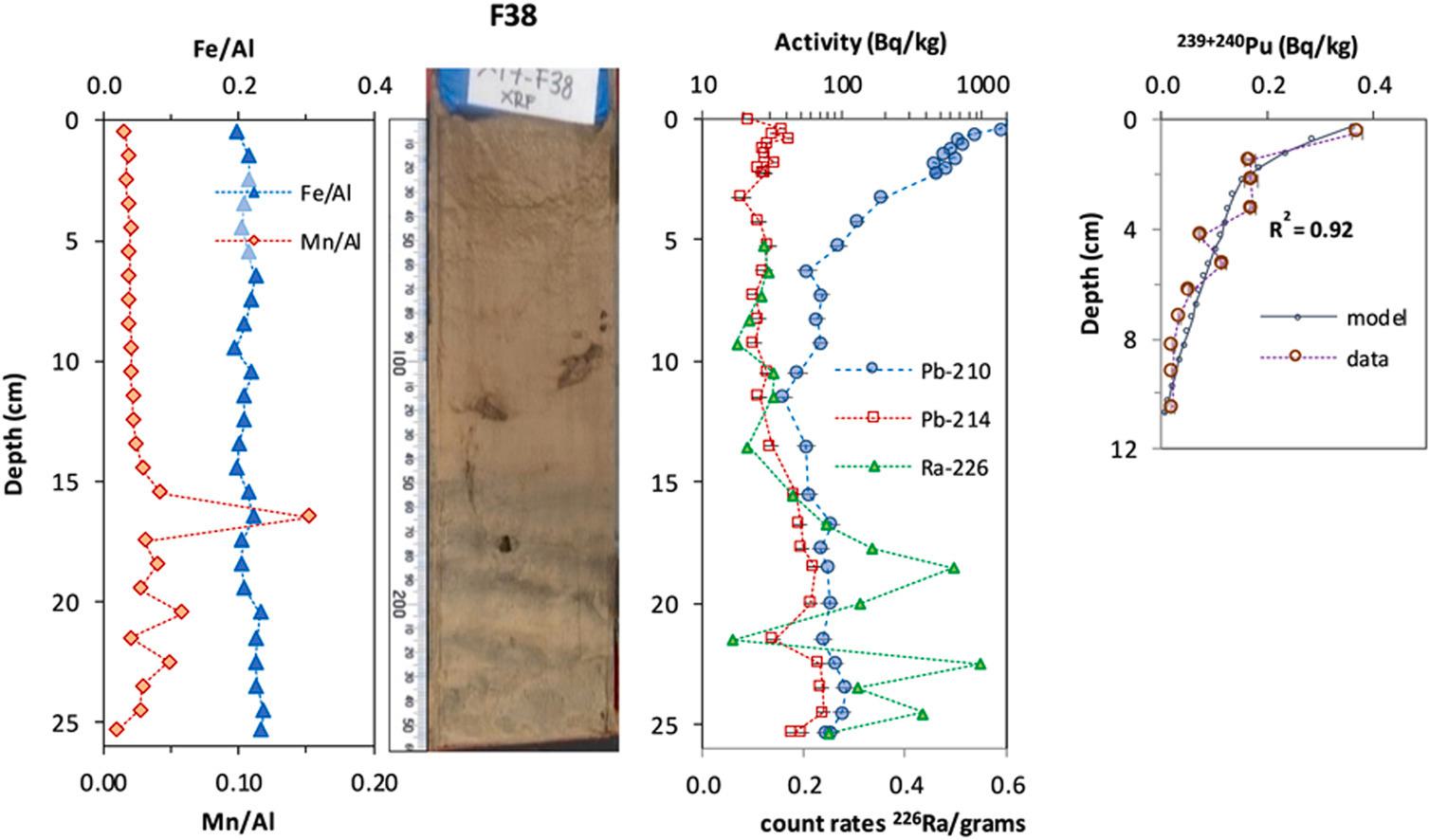
Multi-tracer result aproch in sediment core F38: Radioactive (²¹⁰Pb, ²¹⁴Pb, ²²⁶Ra) and chemical (Mn, Fe, Al) tracers for assessing sediment accumulation and biodiffusion, and comparison of the 239+240Pu activity profile with the advection–diffusion model simulation in sediment core F38.
https://doi.org/10.1016/j.jenv...
M. Díaz-Asencio a b, J.A. Corcho-Alvarado c, O. Díaz-García d, J.C. Herguera b, M.A. Huerta-Diaz e, P.T. Schwing f, R. Larson f, G.R. Brook f, S. Röllin c, L.W. Daessle eaEscuela Nacional de Estudios Superiores Unidad Mérida, UNAM, Mérida, Yucatán, MéxicobDivision of Oceanology. CICESE, Ensenada Center for Scientific Research and Higher Education, Ensenada, Baja California, MéxicocNuclear Chemistry Division, Spiez Laboratory, Federal Office for Civil Protection, Spiez, SwitzerlanddThe Water Institute of the Gulf. Center for Coastal and Deltaic Solutions, Baton Rouge, LA, United States of AmericaeInstituto de Investigaciones Oceanológicas, Universidad Autónoma de Baja California, Campus Sauzal, Carretera Transpeninsular Ensenada-Tijuana, No. 3917, Frac. Playitas, Ensenada, Baja California, CP 22860, MéxicofEckerd College, St. Petersburg, Florida, United States of America
KEY TEAM MEMBERS
